

Nombre de resultats 13
per a Books
01/01/2019 - 2018: Year in Review
Note some links below are Amazon affiliate links. Buy at your own risk 🤣



I made minor contributions (typos, small fixes) to several open source projects (Spark, typeshed, Monix, bloop,...), and also created a couple for my enjoyment: experimenting with Processing in Scala, sbt-ifttt and rb-zsh-theme.


Work
During the first half of this year I have been leading a migration to Spark of several systems, one relatively straightforward and the other based on GraphFrames and a graph with ~1 billion nodes. The results so far seem excellent. The second half of the year has been mostly GDPR compliance improvements (I've read the whole law... twice!), looking for additional large-scale data providers and preparing our systems for global scale (around 6x event data capabilities). Has been fun and challenging.Life
- In February I moved from East Finchley to Chiswick. This meant I became a Friend of Kew Gardens, and have been there almost every weekend I've been in London. And you could catch me a bit earlier at The Coffee Traveller, enjoying a latte with a carrot cake muffin.

- In February, we spent a few days in Puigcerdà for my birthday. Not as nice as we expected. The food was good, though (as expected).
- In March we visited Edimburg again, Laia was attending EdiYarn Festival. I spent the days at Waterstones, eating cupcakes and getting my reading list under control.
- In May I attended AWS Summit in London. Was ok-ish. Lack of coffee made us grumpy.
- In June I attended SoCraTesUK 2018 in Dorking, together with Carlos. I had an excellent time there, and will repeat next year if possible. We presented together Welcome to Apache Spark. I also learnt some Cobol.


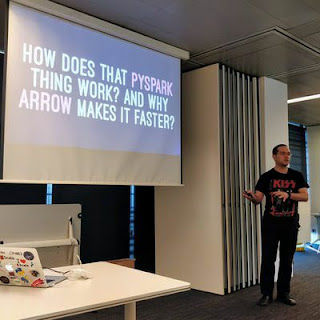
- In June as well, I presented How does that PySpark thing work? And why Arrow makes it faster? at the Python Barcelona meetup. I think people enjoyed it.

- At the end of June we visited Bath for Laia's birthday. Nice town, but a bit packed with tourists. We were lucky England was playing some soccer match and could visit the Roman baths without people.
- In July we published the first podcast of PyBCN (in Spanish). It's not monthly, next one was in... December 😆
- In August we roasted a bit under the heat wave hitting the UK by visiting Mayfield Lavender field.
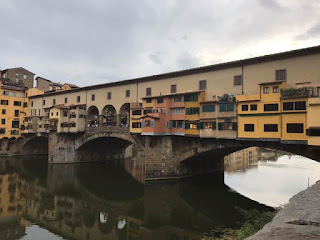
- In September I attended Scala Italy in Florence, where I got the opportunity to visit Osteria del Cinghiale Bianco again. Excellent.

- In September I presented How does that PySpark thing work? And why Arrow makes it faster? at the Spark London meetup, feedback was positive as well.
- In October, I attended Spark Summit Europe in London. Met a lot of people and had a terrific time.

- In October we took a few days off so we could disconnect, and spent them on Hay-on-Wye, as some tradition we follow says. We bought a bunch of books (I think there are no books by Roger Zelazny left there) and I did nothing. Bliss. Also, best scones ever.
- In November I helped a bit from afar with the organisation of PyDay 2018. I couldn't attend, but looked excellent. We also told the world PyBCN is now an organisation you can become a member of.
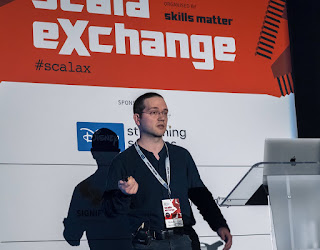
- In December, I attended Scala Exchange for the third time, and gave a lightning talk about TLA+ (Formally Verifying Complex Systems Using TLA+). Looks like people enjoyed my talk, and I had an excellent time as usual.

I made minor contributions (typos, small fixes) to several open source projects (Spark, typeshed, Monix, bloop,...), and also created a couple for my enjoyment: experimenting with Processing in Scala, sbt-ifttt and rb-zsh-theme.
Learning
This year I got a bit deeper into functional Scala, using GraphFrames and (in general) graph operations on big data. Got acquainted and got to hate Apache Airflow. I improved my knowledge of Akka (adding clustering and sharding to the "could do"). I also learned TLA+ and I plan to dive deeper into this rabbit hole the coming year. Started learning Rust. Made some minor stuff using HyperApp, and have been considering learning PureScript so I can write something close to "enjoyable" Javascript. I have also started playing the ukulele.Reading
My top pick for the year is without any doubt Thinking in Systems: A Primer among books I read this year (19 books). Didn't read much non-fiction, and can't recommend any this year. According to Pocket (which I started using around June, after the GDPR fiasco of Instapaper) I read the equivalent to 18 books in blog posts since then.Music/events
This year I attended a couple concerts, both in London: Hayseed Dixie and Steve'n'Seagulls. I ended the year listening to a lot of covers by Leo Moracchioli and progressive metal/instrumental metal like Polyphia (which eventually become boring) and Intervals (which are better). All the links in this section are good renditions by each on YoutubeGadgets
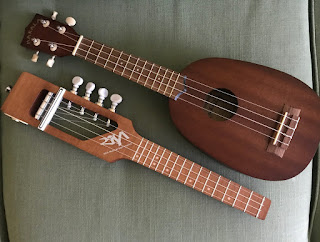
Main one is that Apple finally upgraded the MacBook Air so I can have one with 16GB of RAM, so I got that one as soon as I could. It also implied getting a USB C hub and I also got a power brick, both from Anker, so I could simplify my desktop cable tangles (also several USB A to C and USB C-C cables). In no particular order, I also got- An acoustic ukulele (soprano) and soon after, I got this electric travel ukulele (concert). To go with it I got an AmPlug (clean)

- A mountie very early in the year. Sadly it doesn't work with my new Air, but with the old one it was a blast.
- A Brydge keyboard for my iPad (heavy, but excellent)
- A SoundCore Motion Q speaker from Anker. We're getting another one soon to get stereo. Excellent.
- A Microsoft Wedge Mouse. I saw a picture and when I saw the price (just 17€) I got one. It works very well, and is very small. And works with a rechargeable AA battery, which I like as form factor.
- A eInk display for my Raspberry Pi Zero W.
- An hourglass. I love hourglasses. You can hear the sand from this one.
- A cardholder. I already had a wallet by Bellrow, and they deliver quality.
- A Luna Display (so far a bit disappointed with the inability to map correctly my keyboard layout between Mac and iPad, so can't type at all, but the stream quality is very good)
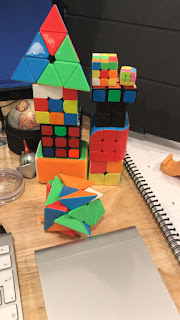
- A bunch of twisty puzzles. I didn't have any 2x2 and I really like it now. Also, magnetic 3x3 are excellent.

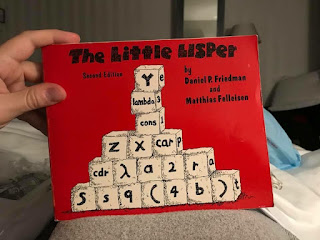
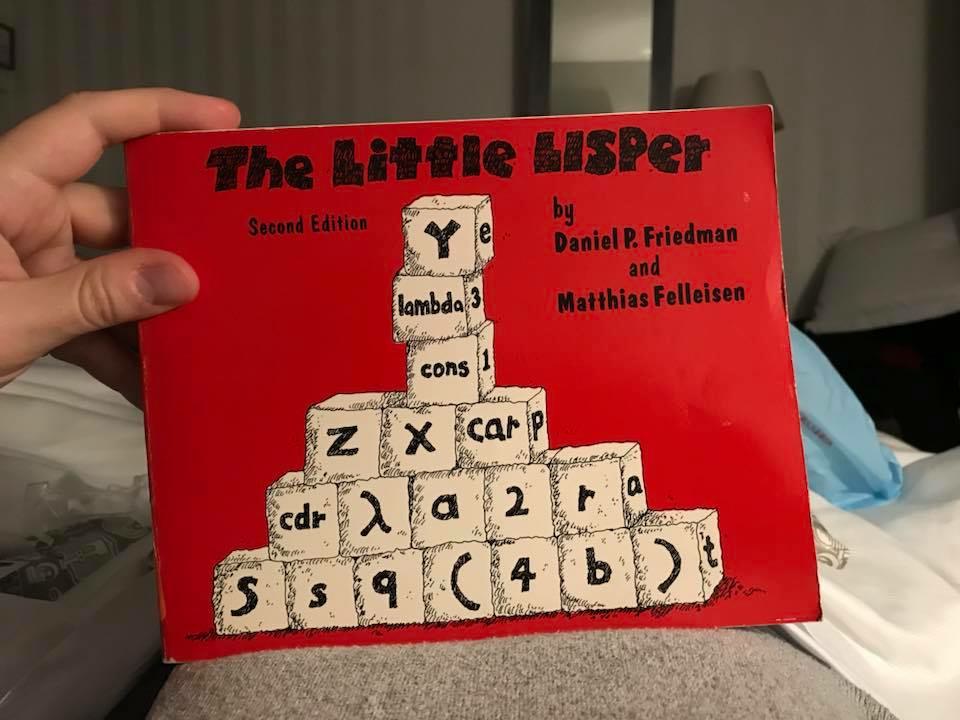
- The Little Lisper for my birthday
- An excellent compact fountain pen from Kaweco (the liliput)
- To go with it, I got a 0.7mm pencil from them as well (the classic brass)
- I got also a 2mm titanium pencil from Kickstarter
- A knucklebone from AroundSquare. Excellent for manipulating while thinking
- A new spinning top, the Rain Drop from NWTops (to join last years' Yakima)
- Several (1, 2, 3, 4) cardistry decks. The Mandala is incredibly gorgeous, the Edge is a design I love (I have the deck as well) and when I saw the trainers I knew I wanted a couple, just because.
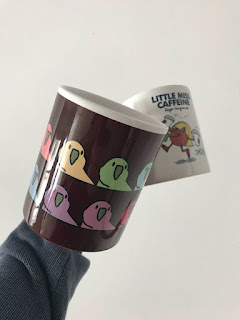
And mugs!


09/03/2018 - Book Review: Work Clean
Down into some net rabbit hole, I stumbled upon a review of Work Clean. I chuckled: a productivity book, philosophizing about how cook’s approach to preparation (mise en place) would fix all our problems? Bring it on, I have a long commute.
Actually, I found the book surprisingly good if you stick to the practical side and discard the hyperbole. As an occasional home cook with a big dose of planning and OCD built into me, I got the point.
Here I’ll share some of the key takeaways I got. I recommend you get the book, by the way.
In more mundane, office style work, this would be part of delegating, communicating and unblocking your peers. Start the day unlocking and unblocking the work of others. Communicating, requesting what you need lets you keep the day going.
Likewise, try to unblock (specially if you are the blocker) your colleagues. If you work in an Agile environment you’ll be familiar with the standup process, where a daily status meeting is quickly held by members of the team, and is when any blockers (operational, logistic, personal) are raised.
(or you can also take the Always be knolling approach)
Keeping a mistake log is the way to continually improve. Find where you failed (no need to be anything life threatening: if you misplace your keys, it’s a failure), log it and strive for improvement. We do this constantly at work: any failure generates a postmortem, and from it we plan to prevent the same mistake from happening again.
Having a clear idea of which kind of actions can be fillers for each of your routines is key to optimizing your time (if you want to).
Actually, I found the book surprisingly good if you stick to the practical side and discard the hyperbole. As an occasional home cook with a big dose of planning and OCD built into me, I got the point.
Here I’ll share some of the key takeaways I got. I recommend you get the book, by the way.
Commit to being honest with time. Plan daily.
If you are anything into GTD (David Allen’s Getting Things Done), daily planning, weekly reviews and in general a big amount of overhead in your system is probably already a given. But this is probably #1 in my book. If you plan your day (preferably the evening before or at least, before really starting it) you’ll have a better sense of where you stand and how you are doing with your day. Proactive, not reactive.Immersive focus vs process time
Remember, anything that needs your input or feedback on a project to keep it moving forward is process work.This is a distinction I had never paid attention to. Process time is work you can “pay in advance�. In a kitchen, this would be starting the oven so it’s hot when you need it, while you chop veggies. Roasting bell peppers: they’ll roast while you prepare something else. Process work was just scrubbing and placing into the oven.
In more mundane, office style work, this would be part of delegating, communicating and unblocking your peers. Start the day unlocking and unblocking the work of others. Communicating, requesting what you need lets you keep the day going.
Always be unblocking
Try to unlock all your projects, goals, missions. The question to ask is what is keeping me from pushing forward? What is the show stopper?Likewise, try to unblock (specially if you are the blocker) your colleagues. If you work in an Agile environment you’ll be familiar with the standup process, where a daily status meeting is quickly held by members of the team, and is when any blockers (operational, logistic, personal) are raised.
(or you can also take the Always be knolling approach)
Counting mistakes: keeping a mistake log
Kaizen is a fabled Japanese term in the manufacturing/productivity world. It is translated usually as constant improvement. But there is nothing to improve if you don’t know where you are failing.Keeping a mistake log is the way to continually improve. Find where you failed (no need to be anything life threatening: if you misplace your keys, it’s a failure), log it and strive for improvement. We do this constantly at work: any failure generates a postmortem, and from it we plan to prevent the same mistake from happening again.
Distraction routines
Another interesting approach. What to do when you can’t concentrate or need a break from your current project? In other words, have tasks, projects or goals for when you don’t feel like working more on what you are doing now. Who has not sorted their closet to avoid other work? This is the same, but without avoiding the important work. It’s only a break.Finisher
Try to finish everything you start. The more projects you have lying around unfinished, the larger burden you’ll feel. If you can’t finish something, prepare the task for picking it up. Write down the next steps, prepare any tools needed. Schedule a follow up session.The approach to routines
Routines, for the author are not actions (nor habits) but placeholders for actions. You can have a commute routine: you are sitting, bring so and so devices, can do so and so. You can fill this routine with several different actions.Having a clear idea of which kind of actions can be fillers for each of your routines is key to optimizing your time (if you want to).
Conclusion
It may not have been a groundbreaking read, but I was surprised by the interesting ideas and the exposition. Focusing on cooks was kind of a fun take for a productivity book, and what made me pick what I would have otherwise skipped. Pick it up, you may get some interesting idea.
06/01/2018 - 2017: Year in Review
I’m trying to make these posts a tradition (even if a few days late). I thought 2016 had been a really weird and fun year, but 2017 has beaten it easily. And I only hope 2018 will be even better in every way. For the record, when I say we, it means Laia and me unless explicitly changed.
Beware, some of the links are affiliate links. I only recommend what I have and like though, get at your own risk :)
As far as my consulting job in London, the most relevant parts would be:
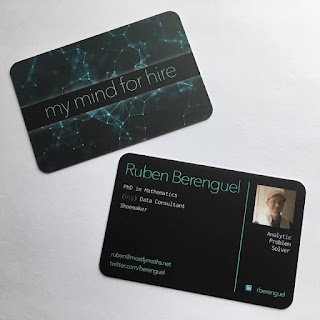
In April I got new business cards (designed by Laia, you can get your own design if you want, contact her):
I kept on helping a company with its SEO efforts, and as usual patience works. Search traffic has improved 30% year-to-year, so I’m pretty happy with it. Let’s see what the new year brings.
I became technical advisor of a local startup (an old friend, PhD in maths is a founder and works there as data scientist/engineer/whatever), trying to bring data insights to small and medium retailers. I help them with technology decisions where I have more hand-to-hand experience, or know where the industry is moving.
Regarding life, the universe and everything, what I’ve done and where I’ve been


I wanted to contribute to the Go compiler code base, but didn’t find an interesting issue. Maybe this year.
This year I didn’t push courses/learning as strongly as last year... Or at least this is what I thought before writing this post.
As far as non-fiction goes, I have specially enjoyed:
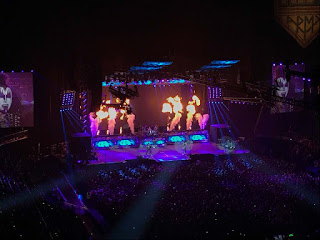
This year I have listened mostly to Sonata Arctica. We attended their concert in Glasgow (March) and it was awesome, they are really good live. This was a build up for KISS at the O2 in London (May) which was totally terrific. And followed by Bat Out of Hell (opening day!) in London. It was great, and probably the closest I’ll ever be to listening Meat Loaf live. Lately I’ve been listening to a very short playlist I have by Loquillo, and also Anachronist.
We have also attended a performance by Penn and Teller (excellent), and IIRC we have also watched just one screening: The Last Jedi (meh, but Laia liked it).
Beware, some of the links are affiliate links. I only recommend what I have and like though, get at your own risk :)
Work
Everything work related has gone up. More work, better work, more interesting work. Good, isn’t it?As far as my consulting job in London, the most relevant parts would be:
- Lead a rewrite and refactor of the adserver (Golang) to improve speed and reliability.
- Migrated a batch job from Apache Pig to Apache Spark to be able to cope with larger amounts of data from third parties (now we process 2x the data with 1/10th of the cost).
- Planned an upgrade of our Kafka cluster from Kafka 0.8.2 to Kafka 0.10.1, which we could not execute as well as planned because the cluster went down. Helped save that day together with the director of engineering when that happened.
- Was part of the hiring team, we’ve had one successful hire this year (passed probation, is an excellent team member and loves weird tech). Hopefully we enlarge our team much more in the coming year.
- Put a real time service in Akka in production, serving and evaluating models generated by a Spark batch job.
In April I got new business cards (designed by Laia, you can get your own design if you want, contact her):
I kept on helping a company with its SEO efforts, and as usual patience works. Search traffic has improved 30% year-to-year, so I’m pretty happy with it. Let’s see what the new year brings.
I became technical advisor of a local startup (an old friend, PhD in maths is a founder and works there as data scientist/engineer/whatever), trying to bring data insights to small and medium retailers. I help them with technology decisions where I have more hand-to-hand experience, or know where the industry is moving.
Life
Traveling up and down as usual (2-3 weeks in London, then l’Arboç, then maybe somewhere else…) sprinkled with some conferences and holidays.Regarding life, the universe and everything, what I’ve done and where I’ve been
- In February we visited Hay-on-Wye again, for my birthday
- In March I convinced Holden Karau (was easy: she loves talking about Spark :D) to be one of our great keynote speakers at PyData Barcelona 2017
- In late March we visited Edinburgh and Glasgow
- In early May I attended PyData London to be able to prepare better for ours. Met some great people there.
- A bit later in May I visited Lisbon for LX Scala, thanks Jorge and the rest for the great work
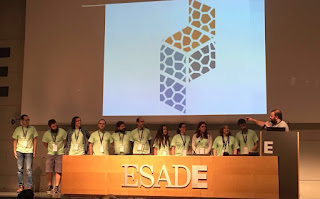
- And at the end of May, we held PyData Barcelona 2017, where I was one of the organisers. We had more than 300 attendees, enjoying a lot of interesting talks. Thanks to all attendees and the rest of the organising committee... We made a hell of a great conference
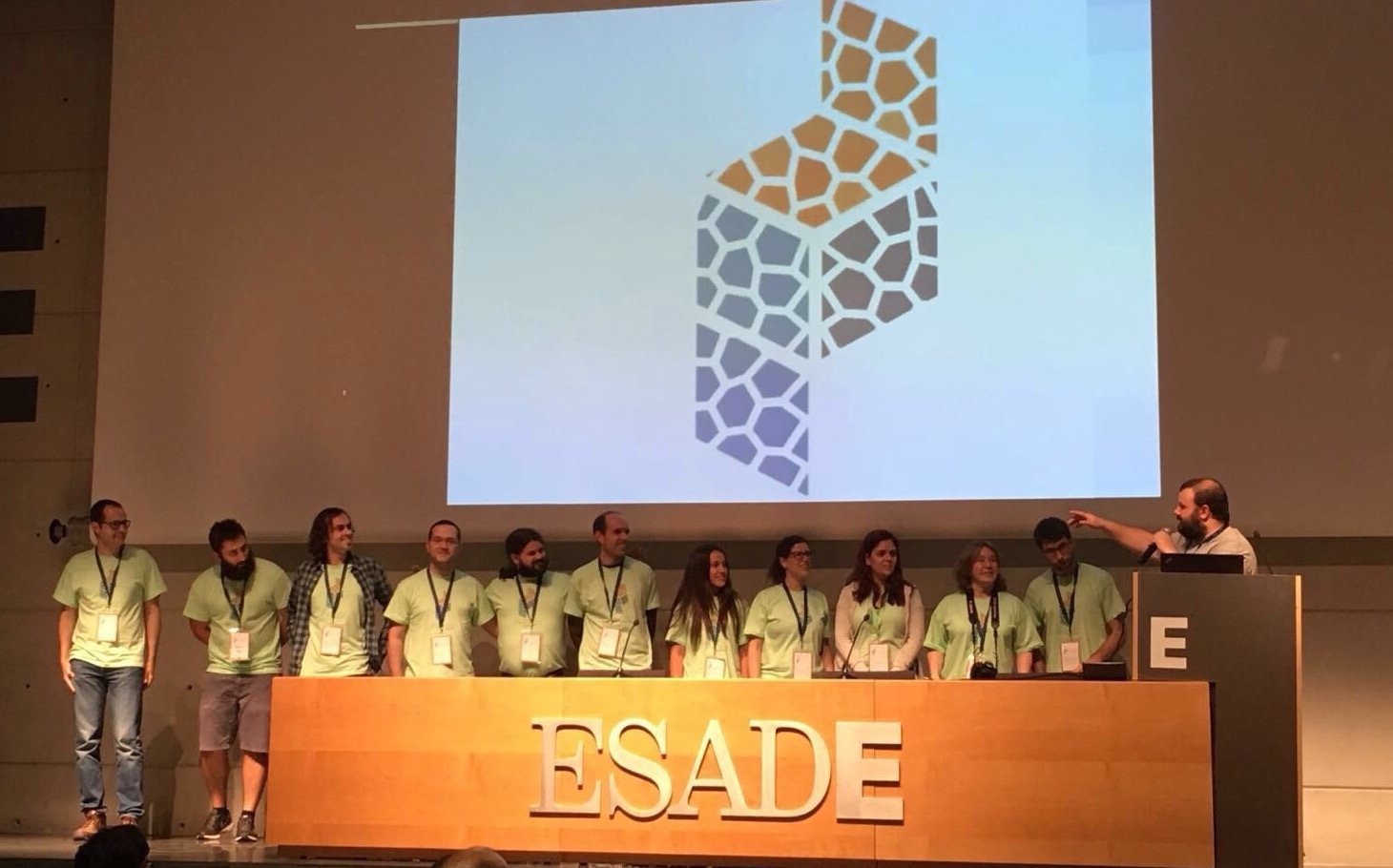
- Mid-June, I gave my first meetup presentation, Snakes and Ladders (about typing in Python as compared with Scala) in the PyBCN meetup
- In late June, we visited Cheddar and Wells

- In September I visited Penrith for the awesome (thanks Jon) Scala World 2017. Looking forward to the 2019 edition.
- In early October we visited San Sebastian for the Python San Sebastian 2017 conference. We ate terribly well there (we can recommend Bodegón Alejandro as one of the best places to eat anywhere in the world now)
- Mid-October we visited Bletchley Park. Nice.
- In late October we (Ernest Fontich and myself) submitted our paper Normal forms and Sternberg conjugation theorems for infinite dimensional coupled map lattice. Now we need to wait.
- In November we visited Brussels (Ghent and Brugge too), and took an unofficial tour of the European Council with a friend who works there.
- In December I attended for the second time Scala Exchange, and the extra community day (excellent tutorials by Heiko Seeberger and Travis Brown). Was even better than last year (maybe because I knew more people?) and I already got my tickets for next year.
- In December we attended a wine and cheese pairing (with Francesc, our man in Brussels, and Laia) at Parés Baltà . They follow biodynamic principles (no herbicides, as natural as they can get, etc) and offer added sulfite free wines, too. They are excellent: neither Laia nor I drink, and we bought 4 bottles of their wines and cavas.
- Apache Spark
- PureConfig
- ScalaFix
- ScalaFmt (well is still pending review and I need to work a bit more on it... had forgotten!)
- Impromptu (a very small thing in a very interesting library, PR merged as I write these lines, technically it was my first PR in 2018)
- Scala Native (the merit goes to Guillaume Massé, I just wrote a POC)
- Spark-Testing-Base

I wanted to contribute to the Go compiler code base, but didn’t find an interesting issue. Maybe this year.
Learning

- In January I enrolled in the Functional Programming in Scala specialisation in Coursera. Only course left is the Capstone project, I will be finishing this January if nothing goes wrong
- During Spring I took Udacity’s Deep Learning Nanodegree Foundation
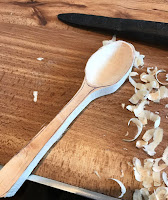
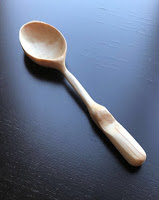
- In May I took a spoon carving course with Forest+Found (they are the authors of The Urban Woodsman and The Wild Dyer)


- In August I took Apache Kafka Series - Learn Apache Kafka for Beginners, with the rest of the courses in the series waiting for me having more time available.
- In September I tried to learn knitting and lace, but it does not seem to suit me.
- In September I enrolled in a weekly Taichi and Qi Gong course by Mei Quan Tai Chi. Will repeat for the next term
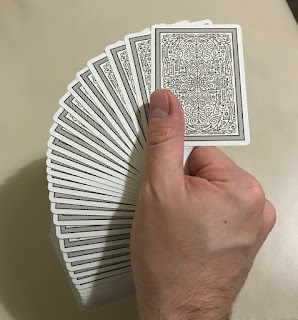
- In December I started learning about Cardistry
Reading
I have read slightly less than last year (36 books vs 44 last year), and the main victim has been fiction. Haven’t read much, and the best... has been the re-read of Zelazny’s Chronicles of Amber. Still excellent. I have enlarged my collection of Zelazny books, now I have more than 30.As far as non-fiction goes, I have specially enjoyed:
- Essentialism: given how many things I do at once, this book felt quite refreshing
- Rich dad, poor dad: Nothing too fancy, just common sense. Invest on having assets (money-generating items) instead of liabilities (money-sucking items, like the house you live in)
- 10% Entrepreneur: Links very well with the above. Being a 10% entrepreneur is a natural way to invest in your assets.
- The Checklist Manifesto: Checklists are a way to automate your life. I have read several books around this concept (“creating and tweaking systems�, as a concept) and it resonates with me. If I can automate (even if I’m the machine), it’s a neat win.
- The Subtle Art of Not Giving a F*ck: Recommended read. For no particular reason. I’ve heard that the audiobook version is great, too.
Music/events

We have also attended a performance by Penn and Teller (excellent), and IIRC we have also watched just one screening: The Last Jedi (meh, but Laia liked it).
Gadgets
This year I have gotten hold of a lot of gadgets. I mention only the terribly useful or interesting- From last year, iPhone 7 “small�. Not happy with it. Battery life sucks big time, I got a external Mophie battery for it.
- Mid-year: Apple Watch Series 2. Pretty cool, and more useful than I expected.
- Late this year: AirPods. THEY ARE AWESOME
- Laptop foldable cooling support. While taking the deep learning course my Air got very hot, and I needed some way to get it as cool as possible.
- Nutribullet. My morning driver is banana, Kit Kat chunky, milk, golden flax seed, guarana.
- Icebreaker merino underwear. I sweat a bit, and get easily chaffed on the side of my legs (where it contacts my underwear). Not any more: not only is wool better at sweat-handling, but the fabric also feels better on the skin. And not, does not feel hot in the summer.
- Double Edge Shaving. I hated shaving (and actually just kept my beard trimmed so it was never a real beard or a clean shave...) and this razor (not this one specifically, safety razors are pretty much all the same) has changed that. Now I shave regularly and enjoy it a lot (together with this soap and this after shave balm)
- Chilly bottles. They work really well to keep drinks cold or hot. I’ll be getting their food container soon.
- Plenty of lightning cables. You can never have enough of these. I also got this great multi-device charger, ideal for traveling.
- Compact wallet. I’ve been shown the ads so many times I finally moved from my Tyvek wallets to one from Bellroy. It is very good.
- Book darts. Small bookmarks that don’t get lost, look great and can double as line markers. Also, they don’t add bulk to a book, so you can have many in the same book without damaging it at all. They are great, I’m getting a second tin in my next Amazon order of stuff.
- Two frames from an artist I saw showcased in our previous office (they had exhibits downstairs). Blue Plaque Doors and Hatchard’s, by Luke Adam Hawker.

19/07/2011 - Book Review: Born to Run, by Christopher McDougall

A very interesting book. I've been thinking about a great and brilliant start of post... But I always go to plain and simple. Easy, it's a great read, and I had a hard time leaving it down: finished it in less than 3 days (amid my usual busy schedule...). The main premise in the book is that humans have evolved to run, not for speed but for endurance. But it is not a dry science book, the book tells a tale. And it is a good one.
You can buy this book from Amazon or The Book Depository (with free international shipping)
The tale is about the author and his contact with a lost tribe of ultra-athletic runners in Mexico, the Tarahumara. A tribe of long distance runners. McDougall found them during his work as a journalist (he has written for several magazines and journals) while researching in Mexico. A long time runner, he always struggled with plantar problems... And saw the picture of a almost bare footed man, running in robe and sandals. After a little research, this was a tribe of distance runners... Without foot or leg injuries. How come he could not run 3 miles without pain and they could run so much without even a pair of running shoes?
Decided to settle this question, he began a quest around Mexico's deserted areas, escaping a few encounters with drug dealers. He was looking for another "searcher", known as Caballo Blanco (White Horse) to the Tarahumara in the middle of the Copper Canyon. His real name, Micah True, ex-fighter who loved long distance running. Met the Tarahumara while he was a bartender in Leadville (host of one of the US ultramarathons), when he was asked to be a pacer for them. In case you don't know, a pacer is someone who enters the race for the last 20 (or so) miles to help the runner keep its rhythm and sanity. After this contact he became mesmerised, and hunted them down Mexico, where he lived on the food people could spare and what he could hunt... While he was running up and down tirelessly.
Just when McDougall arrived, he was planning a race for the next year, the (supposedly) greatest race ever: the Tarahumara against some of the best ultramarathon runners... And he was invited, if he could run! Some intense training and expert advice (explained in the book), mixed with some physiological and anthropological sauce about our evolution to run dress up the remaining of the book until the onset of the race... Which I won't spoil. Go buy and read the book, I bet you won't regret it.
or The Book Depository (with free international shipping)The tale is about the author and his contact with a lost tribe of ultra-athletic runners in Mexico, the Tarahumara. A tribe of long distance runners. McDougall found them during his work as a journalist (he has written for several magazines and journals) while researching in Mexico. A long time runner, he always struggled with plantar problems... And saw the picture of a almost bare footed man, running in robe and sandals. After a little research, this was a tribe of distance runners... Without foot or leg injuries. How come he could not run 3 miles without pain and they could run so much without even a pair of running shoes?
Decided to settle this question, he began a quest around Mexico's deserted areas, escaping a few encounters with drug dealers. He was looking for another "searcher", known as Caballo Blanco (White Horse) to the Tarahumara in the middle of the Copper Canyon. His real name, Micah True, ex-fighter who loved long distance running. Met the Tarahumara while he was a bartender in Leadville (host of one of the US ultramarathons), when he was asked to be a pacer for them. In case you don't know, a pacer is someone who enters the race for the last 20 (or so) miles to help the runner keep its rhythm and sanity. After this contact he became mesmerised, and hunted them down Mexico, where he lived on the food people could spare and what he could hunt... While he was running up and down tirelessly.
Just when McDougall arrived, he was planning a race for the next year, the (supposedly) greatest race ever: the Tarahumara against some of the best ultramarathon runners... And he was invited, if he could run! Some intense training and expert advice (explained in the book), mixed with some physiological and anthropological sauce about our evolution to run dress up the remaining of the book until the onset of the race... Which I won't spoil. Go buy and read the book, I bet you won't regret it.
By the way, last week I ran 20.5 km (in my recently repaired Vibram FiveFingers). A great inspiration to pick your running shoes!
or The Book Depository (with free international shipping).
31/12/2010 - 2011 Is Here. What Do I Want?
- Prepare a mail course on productivity for mostlymaths.net
- Write my book on time management
- Get money from it!
- Submit (at least) another paper for publication. Better if two or more.
- Finish my PhD
- Be able to play a random (easy) guitar score out of the cold
- Open an Etsy shop with Laia
- Make money from the Etsy shop
- Learn enough Icelandic to read the Sagas.
- Start (and finish!) Egil's Saga
- Create (and market!) an iPhone app
The "Related posts" method I use involves Javascript, thus it doesn't work in the RSS feed. To view related posts, please refer to the original article. Thanks!
27/12/2010 - Do you Feel the Smell of Burning Wood? Pyrography Box Beta

Santa brought me the gift I wanted for Christmas: a pyrograph . In case you don't know, a pyrograph is a tool to draw over wood, by burning it.
As you may already know, I love drawing (in particular, ink drawing). This is similar: you don't have a lot of control over tone and a mistake can ruin the drawing.
This was the first time I used one, and to test how it worked I decided to draw a Celtic knot over a wooden box. In the central part I tried a little shading and leaving open areas to get other types of tones. I started with the upper left knotted area, then the center, right and ended with the circle and border. I still have to clean the pencil drawing from the pyrography box, add some detail in the front and add some varnish.
Some tips when starting to use a pyrograph:
. In case you don't know, a pyrograph is a tool to draw over wood, by burning it.As you may already know, I love drawing (in particular, ink drawing). This is similar: you don't have a lot of control over tone and a mistake can ruin the drawing.
This was the first time I used one, and to test how it worked I decided to draw a Celtic knot over a wooden box. In the central part I tried a little shading and leaving open areas to get other types of tones. I started with the upper left knotted area, then the center, right and ended with the circle and border. I still have to clean the pencil drawing from the pyrography box, add some detail in the front and add some varnish.
Some tips when starting to use a pyrograph:
- Trace the contour first, then fill it. It is far easier, and the burn from the trace prevents the burn from the filling to spread to the rest.
- Move quickly, move constantly. If you stop for too long (to get a darker color) you can end with smoked areas (like in the left upper edge). Better to make repeated passes.
- When you start, a Celtic knot is a good option: it is easy (only filled areas) and looks good.
- Adjust the power of your pyrograph. My pyrograph has a scale from 0 to 10. I used 5 in the first area (where I got the smokey part) and then switched to 3 for the rest, except the brownish strings in the center know which were done at 0.6
I'm considering buying some books on pyrography from The Book Depository, but I'm still undecided. The two options are:
- Step by Step Pyrography
- Great Book of Woodburning: Pyrography techniques, patterns and projects for all skill levels
Which one do you think looks better? And what do you think of my first (still unfinished) box?
Related posts:
The "Related posts" method I use involves Javascript, thus it doesn't work in the RSS feed. To view related posts, please refer to the original article. Thanks!
19/12/2010 - Book Review: Do It Tomorrow

A great book!
You should buy this book. I mean it, you know I'm usually not that direct in my reviews, but this is worth it. It is a short book: I recently re-read it in 3 days of reading on my 30 minute commute (i.e. less than an hour daily) and cheap: just 6.70€ (around 8.8$, it is currently 29% off) from The Book Depository, who offer also free international shipping. And it is a book that will definitely change your work life, and these are not the words of Mark Forster, its author, they are my words. It has changed my effectiveness in managing my time for the best.
What makes us feel truly motivated? It is not following our passion (but this definitely helps) or getting a lot of money (although this could also help). According to this book, we can get a real sense of motivation from just being on top of our work. I bet you are thinking this can't be. I thought the same, and you know why we thought it? Because we have never been on top of our work.
Until I finished reading (and applying what I read... this is a key point!) this book, I never had the feeling of arriving home and having nothing more to do, just free time. There was always some paper to read, blog post to sketch or some code to write, and when I went to bed I always had these things in mind. And one day I ticked off all the items in my todo list, and the following day my motivation peaked and I aced a bigger todo list... and this only keeps on getting better until Friday. Just from the ideas from this book.
The first key point is doing it tomorrow. Leaving your tasks for tomorrow is a great way to managing your work, although it may not look like this at first sight. Just like the task scheduler in an operating system, your brain (and your schedule) can only accommodate so many tasks on a given time span (in your case, day). If you plan to do 5 things and during the day you get 10 more and add them to your list... You just can't keep up. The way to solve this problem is simple! All tasks arriving today should be done tomorrow. This way you can be sure to just have to do one day's worth of tasks every day.
Why this works and moreover, how to know when you should do a task today, are the lessons you will learn from reading this book. You will also discover how to really finish your tasks for the day and leave that feeling of tasks and projects pressing over your shoulders, and get some pointers on how to manage long term projects.
You can buy Do It Tomorrow and Other Secrets of Time Management from The Book Depository (free international shipping, and it is currently 29% off!) or from Amazon
 (you can buy a bunch of things besides books from Amazon and then get free shipping).
Related posts:
 Time boxing: you will work like never before Winning Against Your Reading List Book review: How to be #1, by Vince Lombardi
The "Related posts" method I use involves Javascript, thus it doesn't work in the RSS feed. To view related posts, please refer to the original article. Thanks!
17/11/2010 - Creating A6 Booklets in 7 Easy Steps

Disclaimer:Some link in this post are affiliate links. For each sale that is made through the purchase links in this post I get a small commission (that does not affect your final purchase price!). Of course, I'd love if you bought a book through these links, but keep in mind they are in the public domain (and I'll post them in pdf soon). I don't want anyone to come later at me and say they were tricked into buying the book and then realising it was available for free! Anyway, I won't get rich quickly (probably not even slowly) by these sales, but they will work the normal upkeep of this blog.
A few weeks ago I realised that I didn't have a printed copy of Sun Tzu's Art of War, and this thought collided head on with another old thought I had: could I use pdfpages to create A6 booklets? I use it very frequently to turn my papers into handy A4 booklets (a few A4 folded in half), but I did not know if I could do it another time to generate A5 booklets, or even another time to get a small and nice A6 booklet.
As these two thoughts collided, I decided that the best way to check was to use as base PDF The Art of War, a book available through The Project Gutenberg. I formatted it as a LaTeX ebook with custom sizes (to get readable fonts) and compiled using the fantastic and powerful memoir class. I'll give the details of how to create ebooks with LaTeX later this year or in the beginning of the next. I also did the same to Arnold Bennett's How to Live on 24 Hours a Day.
In my next post I'll give you links to the ebooks and A6 and A7 booklet version of The Art of War and How to Live on 24 Hours a Day as a gift for being a reader. For now, I'll show how to create them from any raw PDF and the steps to build the booklet.
You'll need three TeX files, based on the one I already used in How to Create LaTeX Booklets. You can refer to that page if there is something missing in here. These files will turn the PDF successively into 2-pages per sheet to 4-pages per sheet to the final 8-pages per sheet printable booklet.
I named the files Booklet2x1.tex, Booklet4x1.tex and Booklet8x1.tex for pretty obvious reasons. Their contents are:
Booklet2x1.tex:
\documentclass[a5paper]{article}\usepackage[pdftex]{color,graphicx,epsfig}\usepackage[left=2cm,top=2.cm,bottom=2.cm,right=2cm]{geometry}\usepackage[final]{pdfpages}\begin{document}\includepdf[pages=-, signature=80,landscape, frame=true]{Wrapper.pdf}\end{document}
Booklet4x1.tex
\documentclass[a5paper]{article}\usepackage[pdftex]{color,graphicx,epsfig}\usepackage[left=2cm,top=2.cm,bottom=2.cm,right=2cm]{geometry}\usepackage[final]{pdfpages}\begin{document}\includepdf[pages=-, signature=40,landscape, frame=true]{Booklet2x1.pdf}\end{document}
Booklet8x1.tex
\documentclass[a5paper]{article}\usepackage[pdftex]{color,graphicx,epsfig}\usepackage[left=2cm,top=2.cm,bottom=2.cm,right=2cm]{geometry}\usepackage[final]{pdfpages}\begin{document}\includepdf[pages=-, signature=20,landscape, frame=true]{Booklet4x1.pdf}\end{document}
Later I realised that I did not need a5paper in the class part. As I explained in How to Create LaTeX Booklets, the signature is the number of pages per fold: in the case of a booklet, you have to aim for the closest multiple of 4 from above to the number of pages of the PDF file. In this case, I was lucky: the original file had 80 pages, that turned into 40 and then into 20 (resulting in just 10 pages to print).
The building can get a little tricky, because you need to cut correctly the booklet. That is why I used the frame=true option of pdfpages, this draws a thin line around the pages for a very easy cutting process!
Start by compiling the first tex file with pdflatex, and follow with the other files until you have Booklet8x1.pdf and print it two sided.
 | You start with a bunch of pages resulting from the TeX files above |
 | Cut in half to get a few A5 pieces. |
 | And repeat to get A6 slices. Beware! You have to cut to have an A6 booklet consisting of A7 pages, not separate A7 pages! |
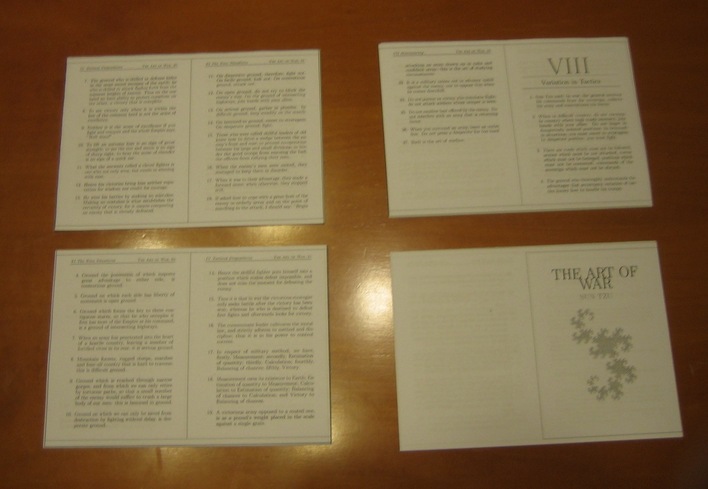 | You'll end with a bunch of small groups of 2 pages (4 pages per sheet). Pile them in a way that the numbers are consecutive. Keep in mind that you will be folding in half, thus on the left you will have page 2 and the right side you will have page 79. On top of this you need to have page 3 and page 78 (covering pages 2 and 79), and so on. If you don't get it know, you'll understand it once you have the pages in front of you, don't worry. |
 | Once you have them neatly folded in half and piled, place them over a soft cloth and staple them along the spine. I usually get by with 2 staples, but feel free to go with one or add a third or fourth. |
 | You are done! Enjoy your pocket reading. If you wish, you can cover in plastic the booklet, it will last longer. |
I hope you found this useful. Stay tuned as I will make freely available the pdf files for The Art of War and How to Live on 24 Hours a Day as pdf ebooks and as printable A6 booklets.
Related posts:
The "Related posts" method I use involves Javascript, thus it doesn't work in the RSS feed. To view related posts, please refer to the original article. Thanks!
08/09/2010 - Newsletter, upcoming ebook
Hi dear readers! I have a few questions for you:

if you feel like it, I will add you to my page of supporters, once I have some :) I don't know how long it will take me to write the ebook, but it will be as full of content as I can, and I will be updating it after completion. I don't know when it will be ready, but when it is I will tell you!


Related posts:
Best Posts I Have Read in June and July 2010


Several readers have asked me to start a newsletter, and I wanted to get some feedback on it. Would you subscribe to my possible newsletter? You can answer by commenting here or sending me an email at  . Or sending me a tweet if you prefer. If you do, I have several questions to ask you:
. Or sending me a tweet if you prefer. If you do, I have several questions to ask you:- nochiel suggested I used MailChimp to send it. Any other suggestions? I don't want to go with the first option, but research a little what else is out there.
- Frequency? I think monthly (at the end of the month) would be best, from my blogging frequency.
- Content? Obviously, a small summary of my month posts, but do you want anything else? Links to interesting posts in other blogs (remember I collect these every two months)?
- Format? I don't know if MailChimp or others default to HTML newsletters, but I can make them in PDF (or PS) if you prefer it.
My other announcement is that I will try to write an ebook! Yes! I will put in writing what I know about time management, goal setting and goal achieving. Of course, if I have a newsletter, newsletter subscribers will be the first to beta test it when it is ready. The price will be easy to remember, free. Of course donations are welcome, you can donate via PayPal
if you feel like it, I will add you to my page of supporters, once I have some :) I don't know how long it will take me to write the ebook, but it will be as full of content as I can, and I will be updating it after completion. I don't know when it will be ready, but when it is I will tell you!
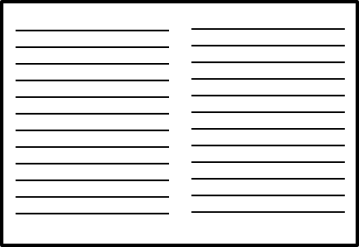
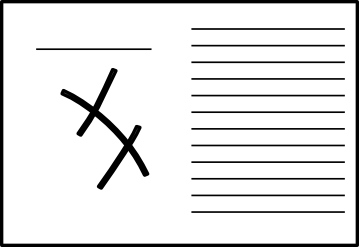
One question about typesetting What do you prefer about orientation and text?

2 columns with text

1 column with text, the other
with miscellaneous data

1 column with text
(big font)

Portrait: 1 column
As before, you can make your choice in the comments below or by sending me an email. You can also drop me a tweet.
I am waiting for your opinions!
Best Posts I Have Read in June and July 2010The "Related posts" method I use involves Javascript, thus it doesn't work in the RSS feed. To view related posts, please refer to the original article. Thanks!
14/06/2010 - Vladimir Arnol'd one of the greatest mathematicians of 20th century
Most of you may not know who Vladimir Arnold (Владимир Арнольд, also written as Vladimir Arnol'd) was, but for me his death on 3rd June 2010,was some kind of landmark. I own two books by him (Mathematical aspects of classical and celestial mechanics [1] and Mathematical methods of classical mechanics [2]), and are quite high in my list of most checked books, at least when I was starting my journey into the realm of dynamical systems.
Arnol'd is one of the few mathematicians to give his name to a theory: Andrey Kolmogorov (Андрей Колмогоров) and Jürgen Moser share with him being part of KAM theory. And this theory traces back to the KAM Theorem.
An integrable system is a dynamical system such that there is a way to see all trajectories as nested tori in the phase space. Think for example of the system generated when you take two bodies and apply Newton's laws of motion: trajectories of the particles follow ellipses (skip some details here) which can be thought as tori in the plane.
KAM theory studies what happens to these tori when you perturb the system: for example, you add a third planet to this. The answer was not clear... Maybe all were broken? How many were left? Kolmogorov had the original idea, and Arnol'd proved all analytical details it in one case, and Jürgen Moser proved another case, using John Nash's implicit function theorem.
This may sound uninteresting... but it has deep implications. A classical question: is the solar system stable? I.e. if you are given a fast-forward controller and start advancing the time, will the planets keep on rolling around... or at some moment will all fall into the Sun (or escape from the solar system)? This is just one of the settings where this applies. Deep physics problems.
Arnol'd had a very geometrical view of mathematics. If you take any of his books you will see his geometrical vision. Just as an example, his Lectures In Partial Differential Equations [3] show more geometrical ideas than in any other book I have read on PDE's (and I have at least leafed through a few of these). He also disliked the formalisation and alienation from physics that started in France in the 50's, he said
Arnol'd is one of the few mathematicians to give his name to a theory: Andrey Kolmogorov (Андрей Колмогоров) and Jürgen Moser share with him being part of KAM theory. And this theory traces back to the KAM Theorem.
An integrable system is a dynamical system such that there is a way to see all trajectories as nested tori in the phase space. Think for example of the system generated when you take two bodies and apply Newton's laws of motion: trajectories of the particles follow ellipses (skip some details here) which can be thought as tori in the plane.
KAM theory studies what happens to these tori when you perturb the system: for example, you add a third planet to this. The answer was not clear... Maybe all were broken? How many were left? Kolmogorov had the original idea, and Arnol'd proved all analytical details it in one case, and Jürgen Moser proved another case, using John Nash's implicit function theorem.
This may sound uninteresting... but it has deep implications. A classical question: is the solar system stable? I.e. if you are given a fast-forward controller and start advancing the time, will the planets keep on rolling around... or at some moment will all fall into the Sun (or escape from the solar system)? This is just one of the settings where this applies. Deep physics problems.
Arnol'd had a very geometrical view of mathematics. If you take any of his books you will see his geometrical vision. Just as an example, his Lectures In Partial Differential Equations [3] show more geometrical ideas than in any other book I have read on PDE's (and I have at least leafed through a few of these). He also disliked the formalisation and alienation from physics that started in France in the 50's, he said
Following this, in the preface to Arnold's problems, he saysMathematics is a part of physics. Physics is an experimental science, a part of natural science. Mathematics is the part of physics where experiments are cheap.
I would wish the reader not to be held back by the fact that such applications are not evident at the beginning: if a result is truly beautiful then it will certainly be of use in due course!Arnold's problems, V.I. Arnol'd [4]
He also chose examples in quite a funny way. See the Arnol'd cat map, for instance. He even drew a cat's sketch to show how an area preserving dynamical system works (it can be found in [1] or [2]).
He was also a fighter for his beliefs. He thought people should be judged on their merits, and not on other things, and as such wrote several letters criticising the persecution of dissidents and discrimination. And as a reward, he could not leave the URSS until the perestroika years.
A funny thing I didn't know about him, is that when he was stuck with a problem he didn't know how to solve, he would ski for 20 or 25 miles wearing nothing but swimming shorts. Or at least that is what one of his former students, Yuli Ilyashenko (Юли Иляшенко) said, as it appears in this Times obituary. And this January I've had the pleasure of attending a course given by him, and he doesn't look like making this up.
I feel ashamed he didn't get an Abel prize prior to his death.
He was also a fighter for his beliefs. He thought people should be judged on their merits, and not on other things, and as such wrote several letters criticising the persecution of dissidents and discrimination. And as a reward, he could not leave the URSS until the perestroika years.
A funny thing I didn't know about him, is that when he was stuck with a problem he didn't know how to solve, he would ski for 20 or 25 miles wearing nothing but swimming shorts. Or at least that is what one of his former students, Yuli Ilyashenko (Юли Иляшенко) said, as it appears in this Times obituary. And this January I've had the pleasure of attending a course given by him, and he doesn't look like making this up.
I feel ashamed he didn't get an Abel prize prior to his death.
References (these are Amazon Affiliate links, I get a small fee if someone buys in Amazon using these links):
- [1] Mathematical Aspects of Classical and Celestial Mechanics
- [2] Mathematical Methods of Classical Mechanics
- [3] Lectures on Partial Differential Equations (Universitext)
- [4] Arnold's Problems


The "Related posts" method I use involves Javascript, thus it doesn't work in the RSS feed. To view related posts, please refer to the original article. Thanks!
30/04/2010 - Oddities from Google Book Preview
A month ago my office mate asked me to check Evans' Partial Differential Equations book (Amazon link) on Google Books, and scroll a few pages ahead. This is what we found there. It appears in a lot of pages... the mighty page advancer! I checked to post a link to the image, but since then they have corrected it.
book (Amazon link) on Google Books, and scroll a few pages ahead. This is what we found there. It appears in a lot of pages... the mighty page advancer! I checked to post a link to the image, but since then they have corrected it.
Have you found other bizarre scanning artifacts in Google Books or Amazon Book Preview?
The "Related posts" method I use involves Javascript, thus it doesn't work in the RSS feed. To view related posts, please refer to the original article. Thanks!
25/04/2010 - St. George: International book day
The 23rd of April is a very special day in Catalonia. The legend of Saint George, in the Catalan version happens in a small town called Montblanc, and when the knight kills the Dragon from its spilled blood grows a red rose he gave to the princess. Since medieval times, men give their a rose to his significant other, and in 1923 something was added to this story.
A bookseller wanted to spice the celebration, and as Miguel de Cervantes and William Shakespeare died on this same day, he promoted the giving of books as a present. Since then, men give roses and women give books (although the mutual exchange of books is customary now).
I gave my girlfriend an origami rose (the diagrams are from here, based on a version of Kawasaki's Rose found in Origami for the Connoisseur , Amazon link) and she gave me an amigurumi dragon. We are strange.
A bookseller wanted to spice the celebration, and as Miguel de Cervantes and William Shakespeare died on this same day, he promoted the giving of books as a present. Since then, men give roses and women give books (although the mutual exchange of books is customary now).
I gave my girlfriend an origami rose (the diagrams are from here, based on a version of Kawasaki's Rose found in Origami for the Connoisseur
, Amazon link) and she gave me an amigurumi dragon. We are strange.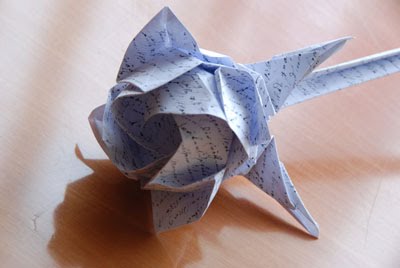
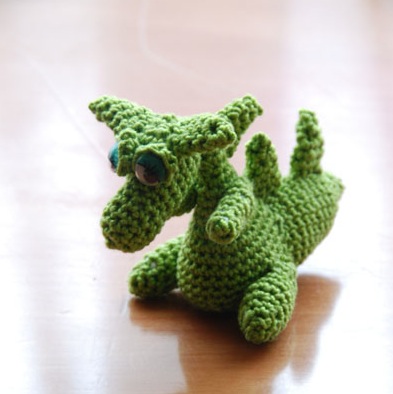
I also bought a standard rose, and she bought me two books: Spade & Archer: The Prequel to Dashiell Hammett's The Maltese Falcon and Primer of Visual Literacy
 (Amazon links). I bought her The Evolution of Calpurnia Tate
 (Amazon link).
and Primer of Visual Literacy (Amazon links). I bought her The Evolution of Calpurnia Tate (Amazon link).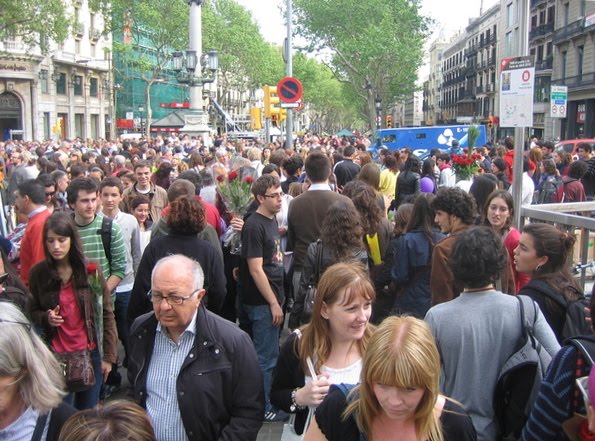
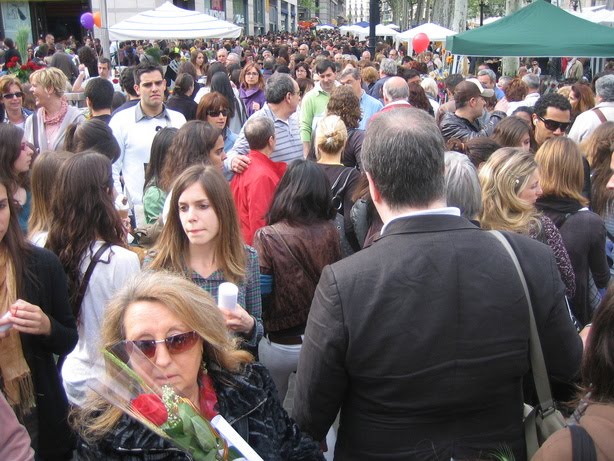
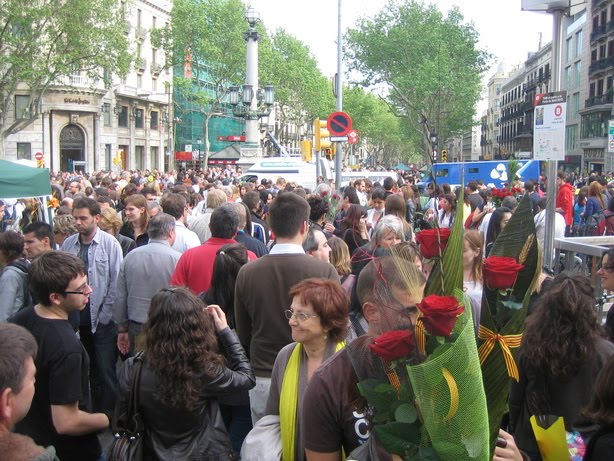
It is a really nice day if you love books and reading (stores and parades offer a 10% price off), but it can be crowded. I tried to make a few pictures to show how crowded it can be, but I guess you need to be here to know. Next year it will be on Saturday, consider coming to Barcelona!
Related posts:
 9 programming books I have read and somewhat liked...
Book review: How to be #1, by Vince Lombardi
Related posts:
9 programming books I have read and somewhat liked... Book review: How to be #1, by Vince LombardiThe "Related posts" method I use involves Javascript, thus it doesn't work in the RSS feed. To view related posts, please refer to the original article. Thanks!
24/03/2010 - Amigurumi Cthulhu
Amigurumi Cthulhu! Evil incarnate...! Or not?If you don't know who Cthulhu is, check wikipedia. I made the body, head and eye-gluing, Laia did the tentacles, wings and sewing.
This came after buying this book (Amazon link) at FNAC. Now she is addicted...She browses for more templates as I write this post.
You may be also interested in:
ParseList(ScrambleList(Relateds(Cooking, Plants)),5)


